Are you curious to learn some weird and wonderful facts about Desmond Tutu?
If so, excellent! You are in exactly the right place my friend…
It’s time to chat about Desmond Tutu facts.
Let’s dive right in…
Facts about Desmond Tutu
1 – Desmond Tutu was born on October 7, 1931.
2 – Desmond Tutu is a South African activist and retired Anglican bishop. In 1985, he became the first black person to be ordained as an Anglican priest in South Africa.
3 – Tutu has written more than 30 books and been given many awards including honorary doctorates from six universities.
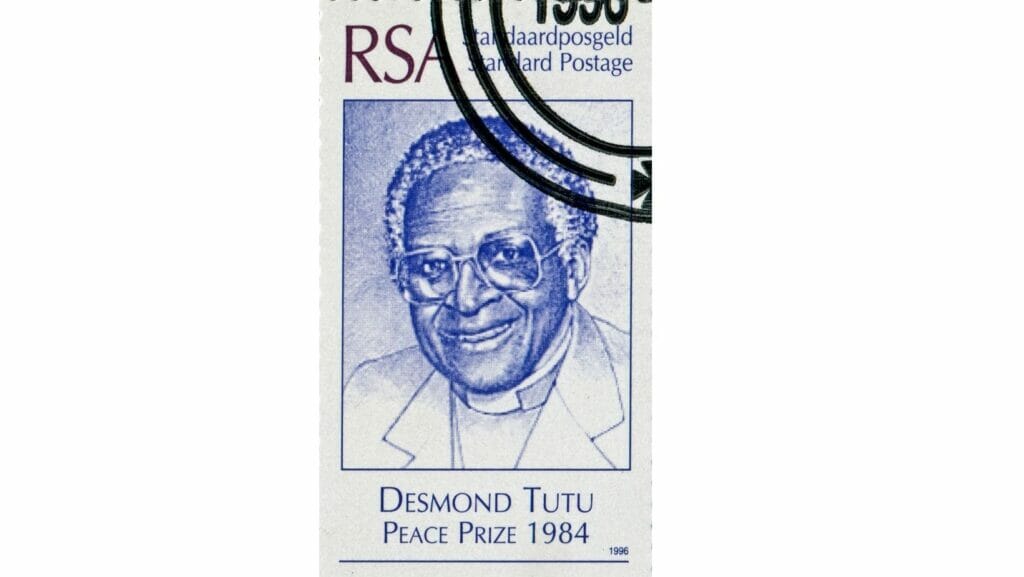
4 – He was awarded the Nobel Peace Prize in 1984 for his work against apartheid.
5 – He has been an advocate for democracy in South Africa.

More Facts about Desmond Tutu
6 – In 1984, he became the first black General Secretary of the South African Council of Churches.
7 – In 1986, he led a delegation to talk with President Reagan about apartheid in South Africa.
8 – He received the Albert Schweitzer Humanitarian Award in 1986 and the Pacem in Terris Award in 1987. In fact Tutu has received more than 90 awards for his work in the field of human rights.
9 – His father Zachariah Tutu was a schoolteacher while his mother Aletta Tutu was a domestic servant.
10 – Tutu was given the name “Tutu” by his grandmother, meaning “my father’s joy” or “gift from God.”

More Facts about Desmond Tutu
11 – He married Nomalizo Leah Tutu when she was 22 and he was 24 on July 2nd, 1955. They had four children: Trevor Thamsanqa, Theresa Thandeka, Naomi Nontombi and Mpho Tutu.
12 – For his work as an anti-apartheid campaigner, he was arrested many times including 1963 when he spent four months at Robben Island prison alongside Nelson Mandela.
13 – In 1984 he helped found the South African Council of Churches (SACC) which became an important voice for opposition to apartheid.
14 – He has been described as “the conscience of the world” by Nelson Mandela.
15 – In 2000 he retired from public life and now spends time writing books and lecturing across Europe and North America about religion, peace, democracy, human rights and reconciliation.

More Facts About Desmond Tutu
16 – Tutu studied at Pretoria Boys High School before moving to England to study theology at King’s College London in 1962.
17 – In 1955 he returned home as assistant curate at St Michael and All Angels Church in Johannesburg.
18 – His activism started with protests against apartheid laws that segregated blacks from whites and led him to be exiled by the government during the 1980s.
19 – Tutu is currently one of the few living people who have been awarded both a Nobel prize (1984) and an honorary knighthood from Queen Elizabeth II (1998).
20 – His activism includes fighting poverty, HIV/AIDS, sexism, homophobia, racism, colonialism or neo-colonialism by any form including economic dependence on other countries for aid or trade with less developed countries; disarmament; nuclear weapons; promotion of democracy through peaceful means; human rights advocacy including women’s rights and gay rights; opposition to capital punishment ; anti-apartheid campaign in South Africa ; support for individual freedom over government authority.

More Facts About Desmond Tutu
21 – In 1984, he was banned from entering South Africa and had to stay in exile until 1990. When he returned to South Africa, he became a vocal critic of the country’s new president, Thabo Mbeki.
22 – In 2003, The United Nations appointed him as a special envoy for HIV/AIDS in Africa.
23 – In 2007, Mr Tutu published a book about apartheid called “No Future Without Forgiveness.”
24 – His activism led to him being detained by apartheid authorities on numerous occasions, including periods when he was banned from entering either Johannesburg or Pretoria without special permission from the government; after release from prison in 1990, Tutu’s public appearances were limited to within Johannesburg until 1994 when apartheid ended.
25 – In 1978, he was elected Archbishop of Cape Town and Metropolitan of Southern Africa – the youngest man ever to hold such a position in the Anglican Church.
He has been involved in many other social justice campaigns, including Greenpeace and Jubilee 2000.
His activism led to him being banned from visiting his homeland because it was deemed “detrimental to the interests of peace” by the Apartheid regime.
Tutu has been the subject of several documentaries including “The Archbishop” by Peter Adair and “Tutu” by David Bradbury.