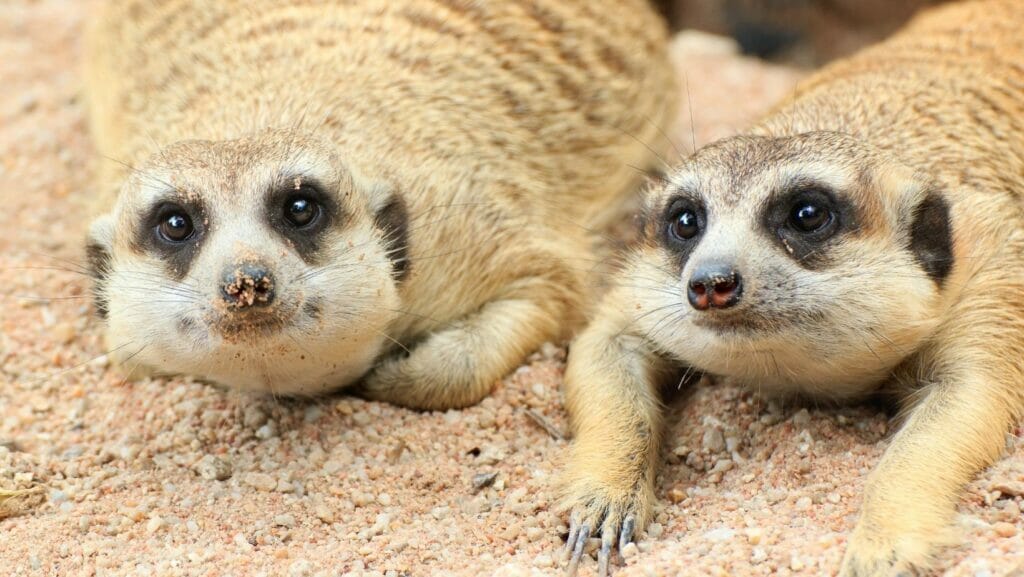
Are you curious to learn some weird and wonderful facts about meerkats?
If so, excellent! You are in exactly the right place my friend…
It’s time to chat about meerkat facts.
Let’s dive right in…
Facts About Meerkats
1 – Meerkats are small African animals that live in large groups called “mobs”.
2 – Meerkat mobs are led by a dominant female who is known as the matriarch of the mob.
3 – The most common predators of meerkats are jackals, eagles, and snake.
4 – Meerkats are social animals that live in colonies of 20-30 members.
5 – They spend most of their day looking for food, digging tunnels and sleeping. A meerkat’s diet consists mainly of insects, spiders, scorpions, centipedes and other small creatures they dig up from the ground or catch with their paws.

More Facts About Meerkats
6 – Their strong claws help them to climb trees where they can find birds eggs and baby birds as well as fruit like figs and berries.
7 – Meerkats have a lifespan of around 10-12 years in the wild but often live longer in captivity.
8 – When threatened by predators such as snakes or jackals, meerkats will mob together to form a circle facing outwards while standing on each other’s shoulders – this is known as “surrounding”. The idea behind this is that if one predator gets through the outer ring then it will be faced with another line of meerkats who will attack it from all sides until it gives up.
9 – Meerkats are small mammals in the mongoose family that live in southern Africa, mainly in dry areas of grassland or scrub desert.
10 – They have a lifespan of about 8-12 years.

More Facts About Meerkats
11 – A meerkat is usually 1 foot tall and weighs 3-5 pounds.
12 – The word “meerkat” comes from the Dutch words for “earth” and “kat”, meaning cat, because they were thought to be related to domestic cats.
13 – There are different types of meerkats, including brown meercats (found in South Africa), white-backed meercats (found on Namibia’s coastal plains), Cape gray meercats (found near Cape Town) and yellow mongrels (found on Botswana’s Kalahari Desert).
14 – A meerkat’s tail is used as a fat storage unit, which they can use to survive during times of famine.
15 – They are social animals that live in large groups called “mobs”. The mob has one dominant pair and several subordinate pairs with offspring from previous years that act as helpers for their parents and siblings.

More Facts About Meerkats
16 – Meerkats are a type of mongoose. They are carnivores and eat insects, small mammals, reptiles, and birds.
17 – Meerkats have poor eyesight but excellent hearing which helps them find food to eat. Their ears are so sensitive they can hear the movement of an insect from 20 feet away.
18 – They also use their sense of smell to help find prey. In order to catch prey, they dig into burrows or earth piles with their sharp claws and teeth.
19 – When predators such as snakes come near the mob will attack it together with biting spines on its back legs that make it difficult for the predator to escape without getting hurt or killed by one of the mob members.
20 – If there is no danger nearby then they spend most of their time sleeping in a nest made out of grasses and leaves.

More Facts About Meerkats
21 – Their babies stay with the meerkat family until they are old enough to go off on their own.
22 – Meerkats have a long tail that is used as a warning system and for balance when they walk on top of rocks or dig up food.
23 – A mob has a dominant female that is usually the mother of the other meerkats. The dominant female will often be pregnant or nursing, and she’ll have at least one male mate who helps her care for her pups.
24 – Meerkat pups stay with their mothers until they’re about six months old.
25 – The meerkat mob has a strict social hierarchy with an alpha male or female leading the group. When a member is removed from the pack (usually by death), it is replaced by a new one from within their ranks – this ensures that no single animal becomes too important to the group’s survival and stability.
BONUS FACTS
They have been observed to act as if they were drunk when eating fermented fruit from the ground.
Male meerkats have an enlarged scent gland on their neck, which they use to mark territory and attract females.
In captivity, meerkat pups will often be weaned at around three weeks of age while in the wild mothers usually continue nursing until about eight weeks old.
There are six different species of meerkats found across southern Africa with one species being threatened with extinction due to habitat loss and poaching by farmers who believe them to be pests because they eat cultivated crops such as maize, sorghum, peanuts, sugar cane and pumpkins.
The meerkat is an endangered species because their habitat has been destroyed by humans for farming purposes, livestock grazing, mining operations, and human settlements.
Meerkats are native to Africa where they can be found in southern African countries like Botswana, Namibia, Mozambique and Zimbabwe as well as South Africa.