
Are you curious to learn some weird and wonderful facts about Neptune?
If so, excellent! You are in exactly the right place my friend…
It’s time to chat about Neptune facts.
Let’s dive right in…
Facts About Neptune
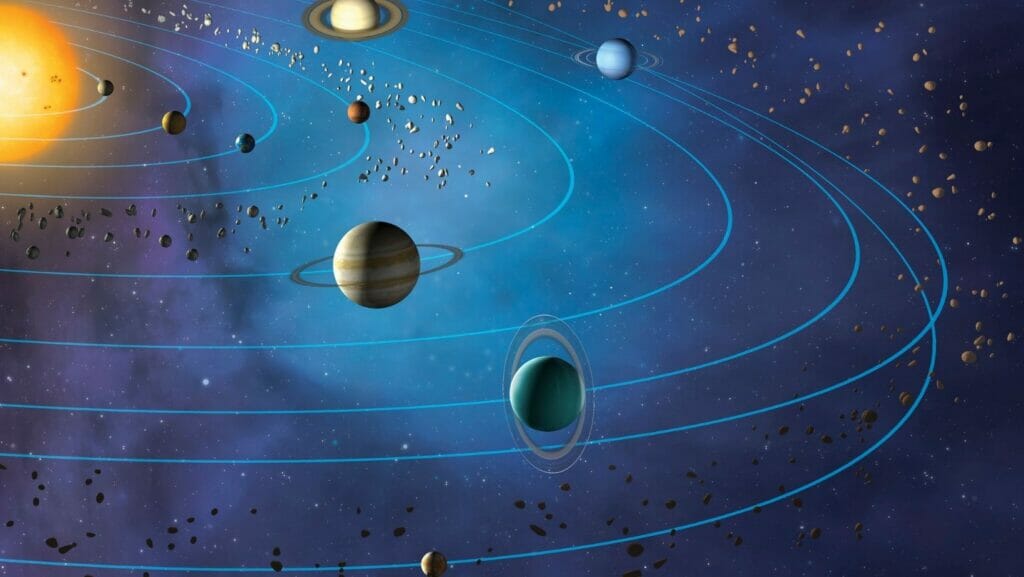
1 – Neptune is the eighth (and furthest) planet from the sun.
2 – Neptune’s atmosphere consists of mostly hydrogen and helium, with small amounts of methane, ammonia, water vapor, carbon monoxide, and nitrogen.
3 – Neptune has a rocky core that takes up about half of its diameter.
4 – Neptune has a very long orbital period – it takes 165 Earth years to complete one orbit around the Sun.
5 – The surface temperature of Neptune can range from -221°C (-360°F) to 23°C (73°F).
More Facts About Neptune
6 – There are features on Neptune’s surface called “Great Dark Spots” which consist of a dark material in an otherwise bright region.
7 – It was named after the Roman god of water and sea.
8 – Neptune has six rings, but they are very faint and difficult to see with a telescope.
9 – The first spacecraft to visit Neptune was Voyager 2 in 1989.
10 – In 1994, astronomers discovered that there is an additional ring around Neptune’s equator called “the Adams Ring.”

More Facts About Neptune
11 – One of its moons is Triton which orbits on a retrograde orbit – opposite to Earth’s rotation.
12 – It has been visited by only one spacecraft, Voyager 2.
13 – It takes 165 years for Neptune to make a full orbit around the sun.
14 – The first person to see Neptune through a telescope was Galileo Galilei in 1612.
15 – Neptune’s atmosphere is mostly hydrogen and helium, but it also contains methane.

More Facts About Neptune
16 – If you were standing on Neptune’s surface you would weigh more than twice as much as on Earth because of its thick atmosphere.
17 – It has a retrograde orbit, meaning it orbits in an opposite direction of most planets.
18 – Neptune was discovered by mathematical prediction rather than direct observation.
19 – The surface of Neptune is made up mostly of water ices and frozen methane gas.
20 – Neptune’s atmosphere contains hydrogen sulfide which gives it its blue coloration.
More Facts About Neptune
21 – Neptune has 13 moons, including Triton, Proteus, Nereid, Despina, Galatea and Larissa.
22 – There are no rings around Neptune like those found around Saturn or Jupiter.
23 – The Great Dark Spot on Neptune was first seen by Voyager 2 when it flew past in 1989.
24 – The Great Dark Spot was thought to be an enormous storm but scientists now believe it may be a hole or vortex that opens up periodically on the surface as air circulates around the planet at different speeds depending on altitude.
25 – The first person to know about the existence of this planet was Galileo Galilei who saw it through his telescope in 1612 but he thought it was just another star because he couldn’t see any details on its surface.
Bonus Facts
It may be possible for life to exist near hydrothermal vents at the bottom of oceans or lakes on earth due to similar conditions existing on Triton.
In 1989 Voyager 2 passed through Neptune’s ring plane (the point where they intersect) and found no detectable particles there; this means that they must have been cleared out by collisions with other objects or had fallen onto one side.